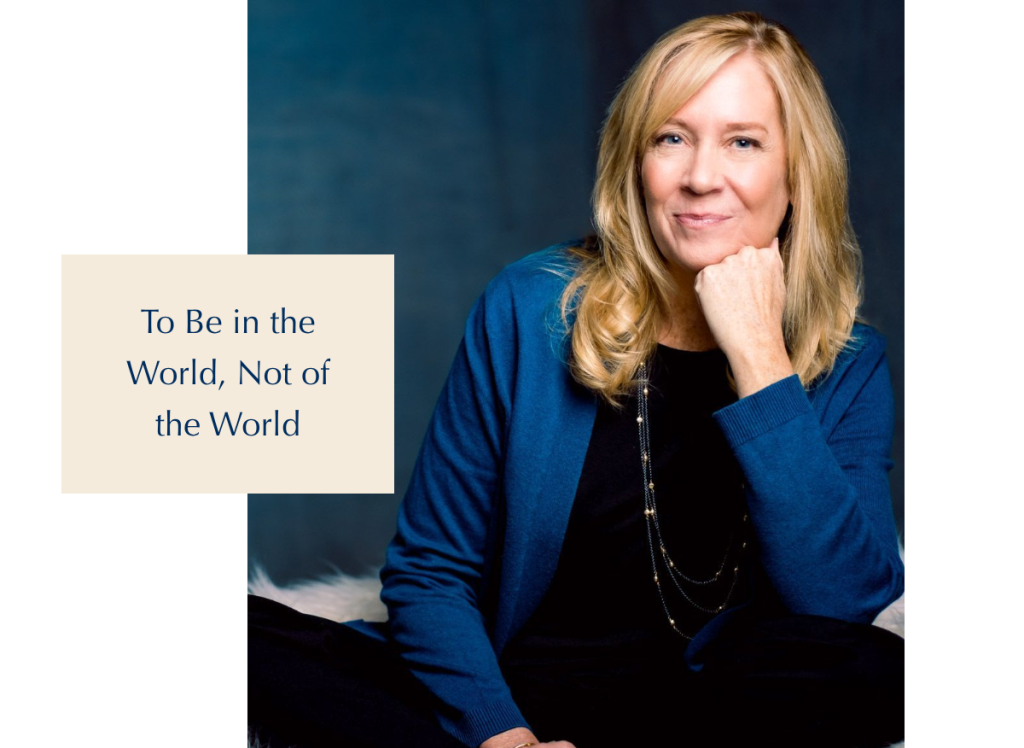
How We Are in the World Matters
One of my favorite quotes—and one I return to in difficult times— is “to be In the world, not of the world”. It helps me re-center myself and remember that I am not only fully human, but also fully divine.
I’ve been thinking lately—and having many conversations with others about—Self-Led Leadership in turbulent times. Not retreating from the world. Not merging with its fear. But standing as a stabilizing field within it.
How do we stay awake, caring, responsive—without being consumed or becoming ineffective?
That is the practice.
How do we hold ourselves?
How do we metabolize intensity?
How do we remain human, awake, and regulated, while truth and fear surface simultaneously?
So much is surfacing right now—disturbing information, collective fear, outrage, grief, disbelief. Many nervous systems are activated. Hearts are heavy. Parts are blended and activated. Minds are searching for solid ground.
You may also notice parts of you that feel outraged, urgent, or called to action — parts that care deeply about justice, protection, and change. These parts are not wrong. They arise from love, from conscience, from a refusal to turn away.
And still, even these well-intentioned parts need support and regulation. When outrage leads, we often burn out, harden, or lose discernment. When Self leads, those same energies can be channeled into wise, sustainable, and effective action.
If you feel overwhelmed, angry, confused, or fatigued, you’re not broken—and you’re not alone. You’re human, and you’re sensing the intensity of a collective field moving very fast.
The question I keep returning to isn’t what side are you on or what do you believe—it’s how are you holding yourself while all of this unfolds?
We are being asked – not to disengage from the world – but to engage from a regulated coherent Self, rather than from fear of collapse.
To be in the world, but not of the world, is not withdrawal.
It’s presence without entanglement.
It’s awareness without reactivity.
It’s care without losing center.
So what does it mean to be embodied—to practice conscious embodiment—right now?
- Pause before consuming more information
- Notice what your body is doing as you engage and read the headlines
- Hand on heart, feet on floor
- Breathe until your system settles before forming opinions or taking action
If we don’t tend the nervous system first, even the most well-intended responses will amplify the very field we’re trying to heal.
Being Self-led in times like these means choosing coherence over chaos, discernment over urgency, and humanity over polarization.
The world doesn’t need more reactivity.
It needs more people who can stand steady inside themselves while staying awake and engaged.
A Note to Fellow Therapists, Physicians and Care Providers
In recent weeks, many of us—therapists, physicians, and care providers—aren’t just hearing about distressing events. We’re feeling them in our own bodies even as we sit with clients.
What I’ve witnessed in sessions is not a matter of politics, but of nervous systems in activation—grief and outrage becoming somatic reality—alongside a deep longing to stay grounded, regulated, and in service.
The question isn’t whether we should think a certain way about current events. It’s how we can remain embodied, regulated, compassionate, and Self-led so that we can truly hold space—without our own fear, anger, emotions co-flooding the room.
Our role is not to join clients in processing from our own activated states, but to stay regulated enough that the therapeutic container remains steady and safe.
Practical Anchors for Providers
- Breathe until your system settles before responding
- Check in with your emotional state before sessions
- If you’re IFS-trained, notice your parts and invite them to step back so Self can lead
- Track somatic cues of mobilization (tight jaw, racing heart, breath holding)
- Use physical grounding: hand on heart, feel on the floor
- Sip water
- Discern what belongs to your parts vs the client’s experience
These aren’t therapeutic platitudes.
They’re regulation practices that allow us to stay in the world—awake, aligned and in service—without being of its reactivity.
Perhaps the deeper invitation of this moment is not to know more, react faster, or fix what feels unbearable—but to become steadier vessels for truth, compassion, and presence.
In times like these, our greatest offering is not our opinion, our certainty, or our analysis, but the quality of our presence. When we stay regulated, embodied, and Self-led, we become a stabilizing field for others. We model what it looks like to remain human, awake, and compassionate without collapsing into fear or reactivity.
May we continue to hold sacred ground—in our lives, in our work, and in our service—remembering that how we are in the world matters as much as anything we do within it.
Our regulated presence is not passive.
It is powerful.
And it is needed.